
Tour Overview
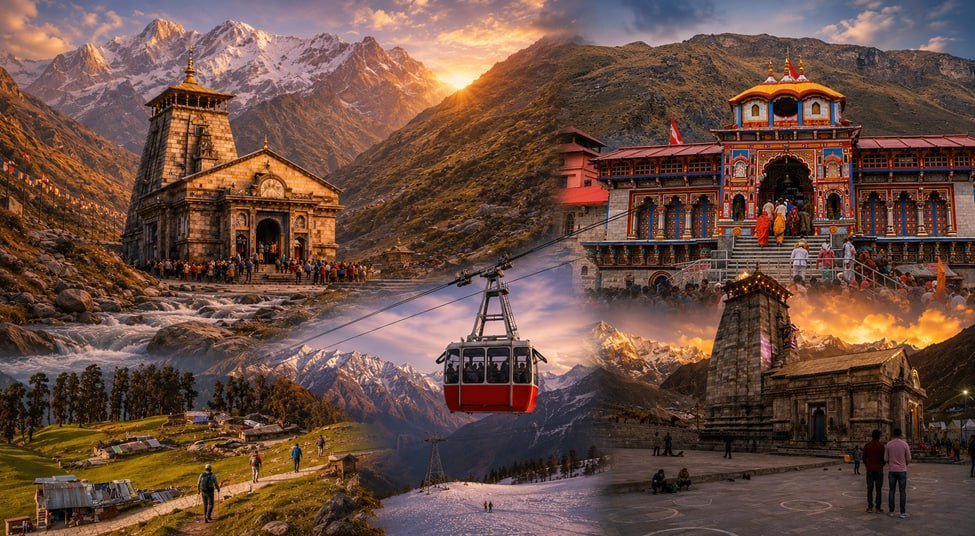
There is a reason pilgrims and travellers alike keep returning to this stretch of Uttarakhand. This Badrinath Kedarnath 12 Days Tour Package with Garhwal Himalayan Expedition moves through some of the holiest shrines in the country, past snow-draped peaks, quiet Himalayan meadows and riverside towns that have drawn seekers for centuries. Starting and ending in Delhi, the route covers Haridwar, Kedarnath, Badrinath, Auli, Chopta, Rishikesh and Mussoorie by private road transfer, giving you the comfort of your own vehicle while the mountains do the rest of the talking.
Day 1: Delhi to Haridwar
The journey begins with a five to six-hour drive covering roughly 230 kilometres, taking you from the capital's noise into the calm of one of India's oldest sacred towns. Har Ki Pauri, the ghat where the Ganga is believed to have first touched earth, sets the tone for what follows. As evening settles in, the Ganga Aarti here turns into a genuinely moving sight, hundreds of diyas floating downstream while priests perform rituals with fire and chant. Those with time can take the optional ropeway up to Mansa Devi Temple before wrapping up the evening at Haridwar's bustling local market. Overnight: Haridwar
Day 2: Haridwar to Guptkashi
A longer day on the road, roughly 220 kilometres and eight to nine hours, but one filled with scenery worth the drive. Devprayag Sangam is the first major stop, the point where the Alaknanda and Bhagirathi rivers meet and officially become the Ganga. Srinagar Garhwal follows, a former capital of the Garhwal kingdom, then Rudraprayag Sangam, another significant river confluence tied deeply to local mythology. Agastyamuni, named after the sage believed to have meditated here, rounds out the sightseeing before you arrive in Guptkashi for the night.
Overnight: Guptkashi
Day 3: Guptkashi to Kedarnath via Gaurikund
This is the day the trip has been building towards. A short drive of about 35 kilometres brings you to Gaurikund, the base point for the trek to Kedarnath. From here, it is a 16 to 18 kilometre trek through changing terrain, forested paths giving way to open mountain trails as the temperature drops and the air thins. Kedarnath Temple itself, one of the twelve Jyotirlingas and among the holiest sites in Hinduism, sits at over 3,500 metres, surrounded by snow-capped peaks that seem to watch over the shrine. Those with energy left can visit Bhairavnath Temple nearby, dedicated to the guardian deity of the region.
Overnight: Kedarnath
Day 4: Kedarnath to Guptkashi
Mornings in Kedarnath carry a stillness that is hard to describe until you have stood there yourself. After an early darshan at the temple, begin the trek back down to Gaurikund. The descent feels easier on the legs but no less scenic, with views that somehow look different heading downhill. From Gaurikund, drive back to Guptkashi for a well-earned rest.
Overnight: Guptkashi
Day 5: Guptkashi to Badrinath
Another substantial driving day, around 210 kilometres and eight to nine hours, passing through Karnaprayag and Nandprayag, both river confluence towns steeped in mythology, before reaching Joshimath, a key gateway town in the region. By evening you arrive in Badrinath, home to the Badrinath Temple dedicated to Lord Vishnu and one of the four sites in the Char Dham pilgrimage circuit. Tapt Kund, a natural hot spring right beside the temple, is where pilgrims traditionally bathe before entering the shrine, believed to have healing properties owing to its geothermal warmth. Overnight: Badrinath
Day 6: Badrinath to Auli via Mana Village and Joshimath
A shorter driving day of about 55 kilometres, but packed with stops. Mana Village, often called the last Indian village before the Tibet border, carries an almost mythical weight, with sites like Vyas Gufa and Ganesh Gufa associated with the writing of the Mahabharata, and Bheem Pul, a natural rock bridge said to have been placed by Bheem himself. The village has a certain mystique, enhanced by the Saraswati River, which disappears underground soon after Mana. From here you can continue to Joshimath and then to Auli, a hill station with meadows and ski slopes. Auli Overnight:
Day 7: Auli Sightseeing
A full day dedicated to Auli's natural beauty. The Auli Ropeway, one of the longest and highest in Asia, offers sweeping views of the Nanda Devi range on the way up. Gorson Bugyal, reachable by an optional trek, opens into vast rolling meadows framed by snow peaks. The Artificial Lake, built to support the region's ski slopes, adds a calm visual contrast against the mountains. During the winter season, the slopes themselves draw skiers from across the country.
Overnight: Auli
Day 8: Auli to Chopta
A drive of roughly 150 kilometres, five to six hours, brings you into Chopta Valley, often described as the mini Switzerland of India for its rolling meadows and dense forest cover. The forest drive alone is worth the journey, deodar and rhododendron lining the route. Those keen on a bit of adventure can attempt the trek to Tungnath Temple, the highest Shiva temple in the world, or push further to Chandrashila Summit for panoramic Himalayan views.
Overnight: Chopta
Day 9: Chopta to Rishikesh
A longer drive of about 165 kilometres, seven to eight hours, taking you back through Rudraprayag and Devprayag before descending into Rishikesh, the self-proclaimed yoga capital of the world. Evening arrives in time for the Ganga Aarti at Triveni Ghat, a slightly different yet equally captivating experience compared to Haridwar's version. A stroll across Ram Jhula and through Rishikesh's local market rounds out the evening.
Overnight: Rishikesh
Day 10: Rishikesh to Mussoorie
A short and scenic drive of 85 kilometres, around three hours, gets you to Mussoorie, the queen of hill stations. Kempty Falls makes for a refreshing stop, its cascading water a favourite among visitors. Gun Hill, accessible by an optional ropeway, offers commanding views of the Doon Valley, while Camel's Back Road provides a peaceful walking trail lined with unusual rock formations. Mall Road in the evening comes alive with shops, cafes and the general buzz of hill station life.
Overnight: Mussoorie
Day 11: Mussoorie Sightseeing
A day set aside to explore Mussoorie properly. Lal Tibba, the highest point in the area, offers telescope views of the Himalayan range on clear days. Company Garden and Mussoorie Lake provide quieter, more relaxed settings, while George Everest Peak, once home to the surveyor after whom the world's tallest mountain is named, adds a bit of history to the views. Cloud's End, true to its name, feels like the edge of everything, and Mall Road remains open for last-minute shopping.
Overnight: Mussoorie
Day 12: Mussoorie to Delhi
The final leg of the journey, roughly 290 kilometres and seven to eight hours, passing through Dehradun with the option of a stop at local markets along the way. Arrival in Delhi by evening brings the tour to a close, with twelve days of temples, mountains and memories that tend to stay with travellers long after they are home.
Tour Ends with Divine Blessings and Beautiful Himalayan Memories
For anyone weighing up a proper Badrinath Kedarnath Tour, this twelve-day format ends up covering the full range of what the Garhwal Himalayas have to offer, from sacred shrines to alpine meadows. Garhwal Himalayan Expedition designs each itinerary to let travellers experience the mountains at their own pace, with comfortable transfers and stays handled every step of the way. Cost depends on availability.
© 2017 Garhwal Himalayan Expedition. All rights Reserved. Developed by ehub.