
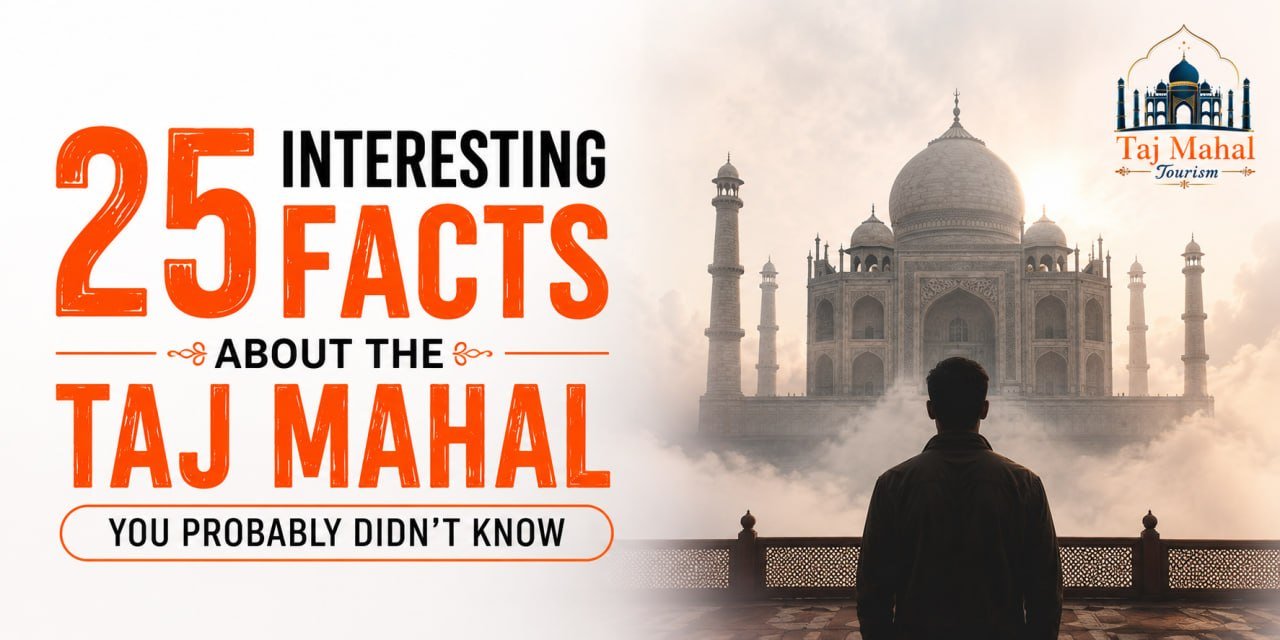
Say "Taj Mahal" to anyone and they will mention love, marble, and Shah Jahan in the same breath. Fair enough, that is the headline. But there is a whole layer of engineering cleverness, family drama, and odd trivia sitting underneath that headline that most visitors never hear about.
Here are 25 facts about the Taj Mahal that go past the version printed on every tourist brochure.
Getting the Basics Straight
- Work on the monument started in 1632 and stretched across roughly 22 years, far longer than the "ten-year build" figure that gets repeated online.
- Somewhere around 20,000 craftsmen and labourers were pulled in from India, Persia, and Central Asia to get the job done.
- Ustad Ahmad Lahauri is generally credited as the lead architect, though historical records never pinned down one official name.
- Marble came from the Makrana quarries in Rajasthan, while gemstones travelled in from places as distant as Sri Lanka, Tibet, and the Arabian Peninsula.
- Nearly a thousand elephants were put to work hauling raw material to the construction site.
Clever Engineering You Would Walk Right Past
- Look closely and the four minarets tilt outward, ever so slightly, a deliberate move so they would collapse away from the tomb during an earthquake rather than crashing onto it.
- Builders raised the entire complex on an elevated platform next to the Yamuna, a choice that helped the foundation resist erosion from the riverbank over the centuries.
- The central dome climbs to about 73 metres and relies on a double-shell construction, inner and outer domes working together, so the structure does not buckle under its own mass.
- Sunlight plays tricks on the marble throughout the day, soft pink at dawn, stark white by noon, and golden by dusk. Purely because of how the stone reflects available light.
- Even the calligraphy was engineered with an optical correction, letters near the top of each panel are sized slightly larger so the text reads evenly from ground level.
The Romance at the Core of It
- Emperor Shah Jahan ordered the construction as a tribute to his wife Mumtaz Mahal, who passed away giving birth in 1631.
- Mumtaz held the position of Shah Jahan's third and reportedly most cherished wife, and she had travelled alongside him during several military campaigns.
- Shah Jahan's own remains rest inside the same mausoleum, positioned beside Mumtaz, though his tomb was never part of the original plan, which is why it disrupts the structure's otherwise flawless symmetry.
- A persistent legend suggests Shah Jahan wanted a matching black marble tomb built for himself on the opposite riverbank, though historians have found nothing concrete to back this up.
- His own son later confined Shah Jahan to Agra Fort for his final years, where the emperor could reportedly only glimpse the Taj from afar.
Details Most Guides Skip
- The surrounding gardens follow a Persian charbagh design, split into four sections representing paradise as envisioned in Islamic tradition.
- Craftsmen used a method called pietra dura to embed cut gemstones directly into the marble, forming the elaborate floral patterns visible throughout the complex.
- Historical estimates put total construction spending above 32 million rupees at the time, a staggering figure by 17th century standards.
- A global public vote crowned the Taj Mahal one of the New7Wonders of the World back in 2007.
- UNESCO added it to the World Heritage list in 1983, recognising both its architectural achievement and cultural weight.
Myths, Disputes, and Odd Trivia
- One popular story claims the builders had their hands severed afterwards to stop them recreating the design elsewhere, a tale most historians reject as pure folklore with zero documentation behind it.
- Pollution and vehicle exhaust once left the marble visibly discoloured, pushing authorities to restrict nearby traffic and apply natural clay packs to bring back its original whiteness.
- The pandemic forced a temporary shutdown, an unusual break in what had otherwise been near-continuous public access since its 1983 heritage listing.
- Cameras are off-limits inside the main tomb chamber, a rule that catches plenty of first-timers off guard mid-photo.
- Despite pulling crowds from across the globe, the monument shuts its doors every Friday for prayers, something worth checking before you lock in your itinerary.
Why This Context Changes How You See It
Carrying these Facts About the Taj Mahal, your visit turns a rushed photo stop into something with actual depth. Suddenly, you are noticing the deliberate tilt in the minarets, the shifting light on the marble, and the asymmetry Shah Jahan's tomb introduced, small things that vanish if nobody points them out.
For travellers who would rather have these stories narrated on site than pieced together afterward, tajmahaltourism.com arranges a comfortable Taj Mahal Tour from Delhi by Car, complete with sunrise slots and guides who walk you through exactly this kind of detail in person. Having someone explain the pietra dura work up close, or point out why the minarets lean the way they do, adds a dimension that no plaque on the wall ever quite manages, and skipping the hassle of public transport or train timings makes the whole day noticeably easier to plan around.
© 2017 Garhwal Himalayan Expedition. All rights Reserved. Developed by ehub.